
NorthStar Capital AdvisorsNorthStar Capital AdvisorsNorthStar Capital AdvisorsNorthStar Capital Advisors
Start Here
  • How We Help
  • Who We Serve
  • Who We Are
  • Fiduciary
  • Podcast
  • Start Here
  • How We Help
  • Who We Serve
  • Who We Are
  • Fiduciary
  • Podcast
  • Start Here

College Graduates Fare Well in Jobs Market, Even Through Recession

  • May 4, 2013/
  • Posted By : admin/
  • 0 comments /
  • Under : Economy

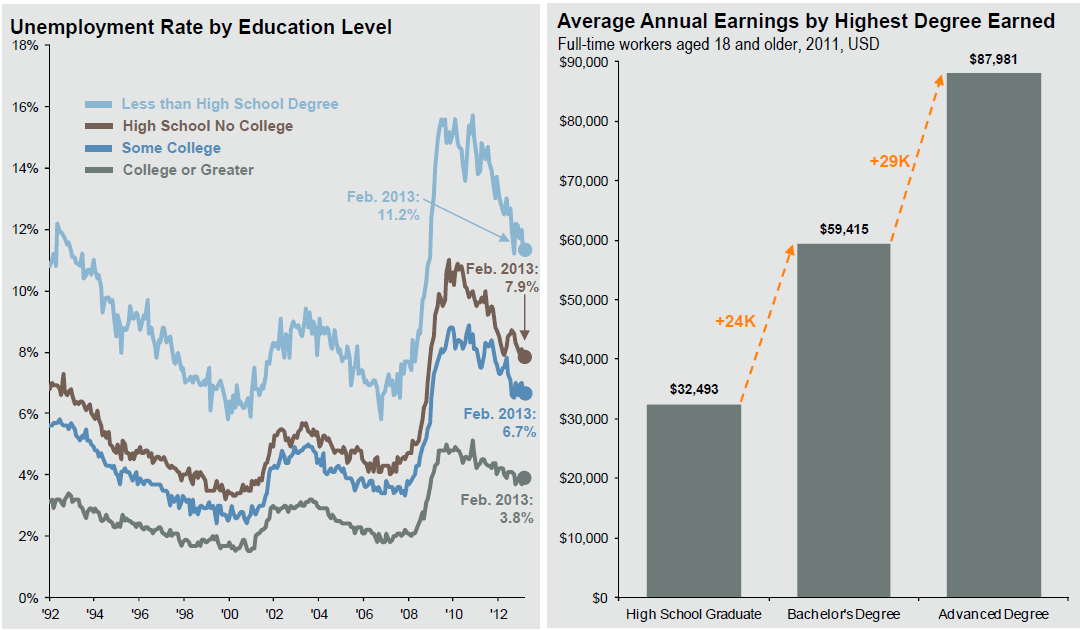
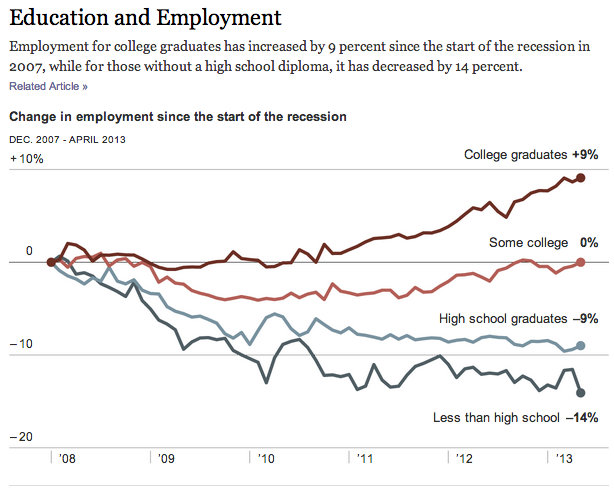
A remarkably stark employment picture in the below New York Times graphic below – the recovery and early stages of the new Knowledge Economy has not been kind to non-college graduates at all.
From the related article:

The number of college-educated workers with jobs has risen by 9.1 percent since the beginning of the recession. Those with a high school diploma and no further education are practically a mirror image, with employment down 9 percent on net. For workers without even a high school diploma, employment levels have fallen 14.1 percent.

See related article:
College Graduates Fare Well in Jobs Market, Even Through Recession



What’s Wrong with the Financial Services Industry?

  • April 25, 2013/
  • Posted By : admin/
  • 0 comments /
  • Under : 401(k), Behavior, Fiduciary, Seeking Prudent Advice

According to Barry Ritholtz, the big problems that plague the financial service industry are the following:

• Simplicity does not pay well: Investing should be relatively simple: Buy broad asset classes, hold them over long periods of time, rebalance periodically, get off the tracks when the locomotive is bearing down on you. The problem is its easier in theory than is reality to execute. And, it is difficult to charge excessive fees for these services.

• Confusion is not a bug, its a feature: Thus, the massive choice, the nonstop noise, confusing claims, contradictory experts all work to make this much a more complex exercise than it need be. This is by design.

• Too much money attracts the wrong kinds of people: Let’s face it, the volume of cash that passes through the Financial Services Industry is enormous. Few who enters finance does so for altruistic reasons. There is a difference between normal greed (human nature) and outright criminality. This is why strong regulators and enforcement cops are required.

• Incentives are misaligned: Too many people lack the patience to get rich slowly. Hence, not only do the wrong people work in finance, and some of the right people exercise bad judgment.

• Too many people have a hand in your pocket:  The list of people nicking you as an investor is enormous. Insiders (CEO/CFO/Boards of Directors) transfer wealth from shareholders to themselves, with the blessing of corrupted Compensation Consultants. 401(k)s are disastrous. NYSE and NASDAQ Exchanges have been paid to allow a HFT tax on every other investor. FASB and Accountants have doen an awful job, allowing corporations to mislead investors with junk balance statements. The Media’s job is to sell advertising, not provide you with intelligent advice. The Regulators have been captured.

Source: The Big Picture


12 Misguided Commandments of Gold Bugs

  • April 18, 2013/
  • Posted By : admin/
  • 0 comments /
  • Under : Seeking Prudent Advice

Gold prices have fallen approximately 10% over the past week.  Prices tumbled 9% on Monday, the biggest one-day loss in 30 years.

Barry Ritholtz of Fusion IQ recently shared his 12 commandments of gold bulls which he says are completely bogus.

Here are his twelve (misguided) gold bug commandments in his own words:

1. Gold is a Currency: This is rule number 1. It is not a decorative or industrial metal, it is a permanent store of value, as dictated by Greeks in Lydia around 700 B.C. And, it shall be ever thus.

2. The price of gold cannot fall, it can only be manipulated lower: When gold’s price falls, it is an unnatural act. It can only occur as the result of an international cabal of Central Bankers and politicians. Its a conspiracy, and we know who the guilty parties are.

3. If the price of gold is rising, it is doing so despite enormous and desperate efforts by manipulators to prevent the rise: This is the corollary to the prior Rule of Gold manipulation. Gold runs up despite the overwhelming opposition to it.

4. The world MUST return to the Gold Standard one day: It is inevitable that we will return to a Gold Standard. We all know this to be true. When we compare the size of the money supply to past amounts when there was a Gold Standard, we can derive prices of Gold in the $7,000, $10,000 even $15,000. Hence, we know its cheap even at $2,000.

5. Central Bankers are printing money relentlessly, and this can only drive Gold prices higher: NOTE: You must ignore, for the moment, that Gold has not gone higher for the past 2 years as Central Banks around the world have ramped up QE. This only means that ultimately, Gold will go much much higher.

6. Gold works whether the economy is good or bad: When we have a red hot economy, Gold is your hedge against inflation. When we have a bad economy, Gold is a safe harbor against collapse. It is a one way trade that never fails!

7. Gold will survive after the world economy crumbles: Gold is the ultimate currency, as it has a value that will survive even after the whole world tumbles around you. Get yourself some gold coins and a Glock and you will be just fine when the whole world goes to shit. We welcome the era envisioned in the movie Mad Max.

8. Never admit that Gold is essentially a sucker’s bet: Never discuss how in the last century, gold has run up only be to trounced in repeated massive sell offs (always blame rule #2 for this). Do not discuss how this has happened in 1915-20, 1941, 1947, 1951-66, 1974-76 1981, 1983-85, 1987-2000 and 2008.

9. Gold is a rejection of government, and their control of fiat money and finance: There are no printing presses that produce gold, it is finite, natural and God created. How much we scrape out of the ground each year is limited, and the only variable to the old equation. (Just ignore Man’s natural tendency to organize into to City-States over the past 12,000 years).

10. All Gold discussions must contain ominous macro forecasts: Your description of why Gold is going higher must consist of spurious correlations, unprovable predictions, and a guarded expectation of bad things in the future. Avoid empirical data at all costs.

11. Gold is always rallying in one currency or another: Sure, it may be down 30% in Dollars, the reserve currency it is priced in, but you can always find a currency falling faster than it does and claim you own it in that denomination. Last week, it was up in Japanese Yen. This week, it is up in Zimbabwe dollars.

12. China & India know the value of Gold; the Western world does not: The massive buying of gold by consumers in Chindia reflects the culture, intelligence and investing savvy of the people in these countries. The West doesn’t get it, and it is their loss.

Bonus rule: Never admit Gold might be falling because it trades on human emotions and psychology and has no intrinsic value whatsoever.


People trust the big banks least

  • April 11, 2013/
  • Posted By : admin/
  • 0 comments /
  • Under : Seeking Prudent Advice

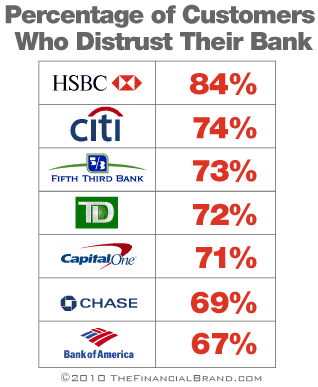
A New York Times article titled “The Least-Trusted Banks in America” cites a Forrester Research study that found customers of the biggest banks in the US don’t believe their financial institution does what’s best for them, but instead does what’s best for their bottom line.

Source: The Financial Brand


Education Still Matters If You Want a Decent Paying Job

  • April 4, 2013/
  • Posted By : admin/
  • 0 comments /
  • Under : Behavior, Economy, Seeking Prudent Advice

Click for larger view

Data: BLS, FactSet, J.P. Morgan Asset Management. Source: Census Bureau, J.P. Morgan Asset Management;  Unemployment rates shown are for civilians aged 25 and older.

Source: JPM Morgan Guide to Markets, Q2 2013


LPL Runs Afoul of Regulators Unusually Often

  • March 28, 2013/
  • Posted By : admin/
  • 0 comments /
  • Under : Retirement, Seeking Prudent Advice

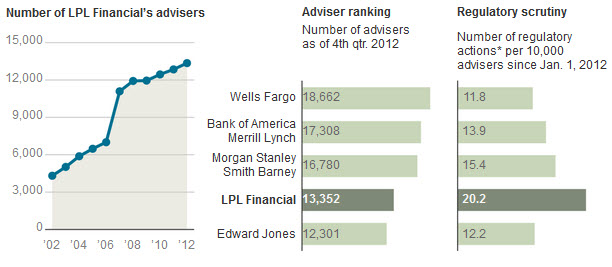
A New York Times article published last Friday tells the story of the 4th largest brokerage firm in America and its frequent run-ins with regulators.

Here are some key excerpts:

LPL Financial, has 13,300 brokers, 6,500 offices, 4.3 million customers — and a growing list of problems with regulators.

State and federal authorities have censured the company and its brokers with unusual frequency.

LPL brokers have been penalized for selling complex investments to unsophisticated investors, for speculative trading in customer accounts, and, in a few cases, for outright stealing from clients.

“LPL is on our radar screen more than any other firm,” said Lynne Egan, who oversees securities regulation in Montana.

Since the financial crisis hit in 2008, prominent firms like Merrill, which long catered to individual investors, have lost brokers and customers. Many investors have turned instead to independent brokerage firms like LPL. Unlike employees of the industry giants, LPL brokers are essentially contractors. They get LPL e-mail addresses and come under LPL compliance but pay for office space and staff.

LPL’s most serious case in Montana was resolved in 2009, when Donald Chouinard, an LPL broker in Kalispell, was sentenced to 10 years in prison for operating a Ponzi scheme. LPL paid Mr. Chouinard’s clients $1.3 million, and Ms. Egan’s office a $150,000 fine.

William F. Galvin, the Massachusetts secretary of the commonwealth, came to a $2.5 million settlement with LPL in February for selling the same product to investors in his state. Mr. Galvin said LPL had failed to properly examine who the products were being sold to, and had pushed the investments without mentioning that they provided big commissions to LPL and its brokers.

“What we really saw was a complete lack of supervision,” Mr. Galvin said.


2012 IRA Contribution Reminder

  • March 21, 2013/
  • Posted By : admin/
  • 0 comments /
  • Under : Retirement

Here’s an important reminder if you have an individual retirement account (IRA) or are considering opening an IRA.

2012 contributions to your IRA accounts can still be made up through April 15, 2013.

IRA Contribution Limits for 2012*

Traditional/IRA Rollover: $5,000 ($6,000 if you are 50 years old or older)
Roth IRA: $5,000 ($6,000 if you are 50 years old or older)
SIMPLE IRA: $11,500 ($14,000 if you are 50 years old or older)
SEP IRA: $50,000

*Note: The maximum contribution limit is affected by your taxable compensation for the year. Refer to IRS Publication 590 for full details.


Money Lessons From “Downton Abbey”

  • March 14, 2013/
  • Posted By : admin/
  • 0 comments /
  • Under : Behavior, Seeking Prudent Advice

We’re big fans of “Downton Abbey”, the television show that follows an aristocratic British family in the early decades of the 20th century.

Over the three seasons that the show has graced PBS’ “Masterpiece”, a number of money lessons have been showcased — mostly what NOT to do!

For example, don’t bet the family fortune on a railroad thousands of miles away (i.e., massive lack of diversification).  A professional advisor working in concert with the Earl of Grantham probably would have prevented him from concentrating so much capital in a Canadian railway!

Downton’s money lessons include financial and estate-planning disasters, bad investments, messy trusts, and inadequate business succession plans.

Here are some key takeaways and tie-ins:

  • Spell out control and ownership when passing the baton of a family company
    (the generational transfer of Downton Abbey from Robert to Matthew)
  • Use trusts to protect the family fortune
    (to protect Robert Crawley’s from his own poor decisions)
  • Make a will before giving birth
    (think of Matthew Crawley’s untimely demise)
  • Set up a medical directive
    (the terrible struggle of how to handle Sybil in childbirth)

We can’t wait for more Dowton Abbey and money lessons in season four!


Dow at All-Time High: What Has Changed?

  • March 7, 2013/
  • Posted By : admin/
  • 0 comments /
  • Under : Economy, Market Outlook

Click for larger view

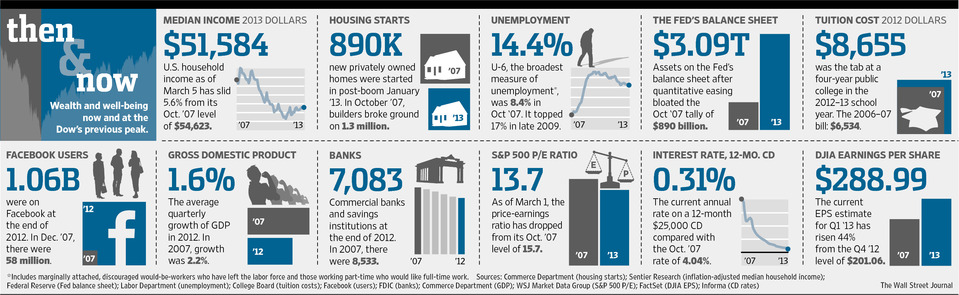
The Dow climbed to 14253.77 on Tuesday to set a new all-time high. The economic landscape has changed a great deal since the previous record was set in October 2007:

  • GDP Growth: Then +2.5%; Now +1.6%
  • Unemployed: Then 6.7 million; Now 13.2 million
  • Food Stamp users: Then 26.9 million; Now 47.69 million
  • Fed’s Balance Sheet: Then $0.89 trillion; Now $3.01 trillion
  • Debt as a Percentage of GDP: Then ~38%; Now 74.2%
  • Total US Debt: Then $9.008 trillion; Now $16.43 trillion
  • Consumer Confidence: Then 99.5; Now 69.6
  • VIX: Then 17.5%; Now 14%
  • 10 Year Treasury Yield: Then 4.64%; Now 1.89%
  • Gold: Then $748; Now $1583
  • NYSE Average daily volume: Then 1.3 billion shares; Now 545 million shares

Source: WSJ


Guide to Car Buying and Leasing

  • February 28, 2013/
  • Posted By : admin/
  • 0 comments /
  • Under : Seeking Prudent Advice

Our friends at the The Big Picture have published an excellent and very up-to-date guide to buying and leasing a car.

Here’s an overview of how to expertly navigate this process while saving time and money.

1) Set Up Your Online Shopping Identify:

Get a Google Voice account (its free) then get a LeeMail account (its free). These are the only numbers/addresses you use until you decide which car you are getting from which dealer.

2) Do your homework: Before you ever step foot on a dealer’s lot, you need to figure out a few things:

a) What kind of transport? Are you looking for a minivan, convertible, truck, coupe, SUV, etc.
b) The range of competitive vehicles for that car type
c) Your actual budget (including your “bottom line” monthly price)
d) Buy or Lease? (see #3)

3) Buy or lease? Most people should own, not lease cars. Its better not to pay for just the most expensive years of a depreciating asset.

The exception is if you can lease with pre-tax dollars — if you own (or are senior enough in) a company, than a lease may be a great deal. But without that tax advantage, the numbers favor owning.

4) Know Your Price Range and Approximate Cost of Cars: All of the cars I mentioned have extensive websites where you can build and price vehicles. You end up with MSRP.

5) Understand Factors Which Impact Pricing: The cost of any given car is a function of its retail price (MSRP), specific programs dealers are running, financing, what is hot or not, and other factors.

6) Be aware of the sales routine: If you followed steps 1-5, you know the approximate cost of the car, plus the options you want, and how that prices it.

7) Understand the buying/leasing math: The purchase math is simple: Negotiated cost of car plus financing expenses.

8) Use Online Salespersons: I asked several dealers for quotes on cars. If they ignored my request for an emailed quote and called, I held that against them. Different dealers have differing demands for specific cars. Some of the deals were very competitive .

9) Go to Competing Dealerships: Don’t be afraid to cast a wide net.

10) Use a car buying service:  That was the suggestion for people who are too busy or intimidated or who simply dont want to be bothered. Leading suggestions: USAA, Credit Unions, and (mulitple recommendations) CostCo.

Check out TBP’s full guide at http://www.ritholtz.com/blog/2013/02/guide-leasing-buying/


« First‹ Prev42434445464748Next ›Last »
Recent Posts
  • Cometary Globule CG 4
    Real Estate Investing — Love It or Leave It? April 2,2026
  • Arp 4
    5 Conversations Every Couple Needs Before Retirement March 19,2026
  • The Exposed Cranium Nebula
    Timing Social Security and Taming Scary Markets March 5,2026
  • Egg Nebula
    Don’t Make These Mistakes on Your Tax Return February 19,2026
  • Gayle Riggsbee & Chris Mullis
    Tuscan Sun or Fool’s Gold? Navigating Global Moves and Market Hype February 5,2026
Archives
  • April 2026
  • March 2026
  • February 2026
  • January 2026
  • December 2025
  • November 2025
  • October 2025
  • September 2025
  • August 2025
  • July 2025
  • June 2025
  • May 2025
  • April 2025
  • March 2025
  • February 2025
  • January 2025
  • December 2024
  • November 2024
  • October 2024
  • September 2024
  • August 2024
  • July 2024
  • June 2024
  • May 2024
  • April 2024
  • March 2024
  • February 2024
  • January 2024
  • December 2023
  • November 2023
  • October 2023
  • September 2023
  • August 2023
  • June 2023
  • May 2023
  • April 2023
  • March 2023
  • February 2023
  • January 2023
  • November 2022
  • October 2022
  • September 2022
  • August 2022
  • July 2022
  • May 2022
  • April 2022
  • March 2022
  • February 2022
  • December 2021
  • October 2021
  • September 2021
  • August 2021
  • July 2021
  • June 2021
  • May 2021
  • April 2021
  • March 2021
  • February 2021
  • January 2021
  • December 2020
  • November 2020
  • October 2020
  • September 2020
  • August 2020
  • July 2020
  • June 2020
  • May 2020
  • April 2020
  • March 2020
  • November 2019
  • October 2019
  • June 2019
  • May 2019
  • April 2019
  • March 2019
  • February 2019
  • January 2019
  • December 2018
  • November 2018
  • October 2018
  • September 2018
  • August 2018
  • July 2018
  • June 2018
  • May 2018
  • April 2018
  • March 2018
  • February 2018
  • January 2018
  • December 2017
  • November 2017
  • October 2017
  • September 2017
  • August 2017
  • July 2017
  • June 2017
  • May 2017
  • April 2017
  • March 2017
  • February 2017
  • January 2017
  • December 2016
  • November 2016
  • October 2016
  • September 2016
  • August 2016
  • July 2016
  • June 2016
  • May 2016
  • April 2016
  • March 2016
  • February 2016
  • January 2016
  • December 2015
  • November 2015
  • October 2015
  • September 2015
  • August 2015
  • July 2015
  • June 2015
  • May 2015
  • April 2015
  • March 2015
  • February 2015
  • January 2015
  • December 2014
  • November 2014
  • October 2014
  • September 2014
  • August 2014
  • July 2014
  • June 2014
  • May 2014
  • April 2014
  • March 2014
  • February 2014
  • January 2014
  • December 2013
  • November 2013
  • October 2013
  • September 2013
  • August 2013
  • July 2013
  • June 2013
  • May 2013
  • April 2013
  • March 2013
  • February 2013
  • January 2013
  • December 2012
  • November 2012
  • October 2012
  • September 2012
  • August 2012
  • July 2012
  • June 2012
  • May 2012
  • April 2012
  • March 2012
  • February 2012
  • January 2012
  • December 2011
  • November 2011
  • October 2011
  • September 2011
  • August 2011
  • July 2011
  • June 2011
  • May 2011
  • April 2011
  • March 2011
  • February 2011
  • January 2011
  • November 2010
  • October 2010
  • September 2010
  • August 2010
Categories
  • 401(k)
  • Annuities
  • Behavior
  • Best Practices
  • Bonds
  • Charitable Donations
  • Economy
  • Fees
  • Fiduciary
  • Financial Planning
  • Investing 101
  • Live Well
  • Market Outlook
  • Mutual Funds
  • NorthStar
  • Performance
  • Personal Finance
  • Planning
  • Retirement
  • Saving Money
  • Scams & Schemes
  • Seeking Prudent Advice
  • Tax Planning
  • Uncategorised
  • Uncategorized
  • Weekly Market Review
ABOUT US

We are a fee-only, independent fiduciary advisor. Our allegiance rests solely with our clients and their best interests. We are headquartered in Charlotte, North Carolina and serve client families across the nation.


CLIENT TOOLS
CONTACT
  • (704) 350-5028
  • info@nstarcapital.com
  • 521 East Blvd, Charlotte, NC 28203
    (by appointment only)
  • fax: (704) 626-3462
RETIREMENT ISN’T ROCKET SCIENCE PODCAST
  • Cometary Globule CG 4
    Real Estate Investing — Love It or Leave It? April 2,2026
  • Arp 4
    5 Conversations Every Couple Needs Before Retirement March 19,2026
  • The Exposed Cranium Nebula
    Timing Social Security and Taming Scary Markets March 5,2026
Nothing on this website constitutes either the provision of investment advice or solicitation to provide investment advice.
Investment advice can only be provided through a formal investment advisory relationship.