
NorthStar Capital AdvisorsNorthStar Capital AdvisorsNorthStar Capital AdvisorsNorthStar Capital Advisors
Start Here
  • How We Help
  • Who We Serve
  • Who We Are
  • Fiduciary
  • Podcast
  • Start Here
  • How We Help
  • Who We Serve
  • Who We Are
  • Fiduciary
  • Podcast
  • Start Here

Simple, Bedrock Rules on Personal Finance

  • February 12, 2015/
  • Posted By : admin/
  • 0 comments /
  • Under : Best Practices

rulesFinancial columnist Brett Arends’ final piece for the Wall Street Journal is absolutely foundational!

Ignore economic and financial forecasts. Their purpose is to keep forecasters employed. Most professional economists were blindsided in 2008 by the biggest financial collapse in 70 years—and by the stock market’s recovery.

Ignore “expert” stock picks. The stocks that Wall Street experts like most generally fare no better than those they like least—or stocks picked at random.

Keep it simple. Complicated financial strategies and investments are mostly designed to enrich managers and salesmen.

Buy individual stocks only as a gamble. Never buy fashionable investments.

Put most of your long-term portfolio into equities. While equities are volatile, they generally produce the best long-term returns—typically about 4% to 5% a year above inflation. But remember to hang on when they plummet.

Invest globally, not just in the U.S. Foreign stock markets, in the aggregate, are no riskier than U.S. markets and offer terrific diversification.

Buy Treasurys, too: In addition to stocks, own some long-term Treasury bonds and some Treasury inflation-protected securities. These are likely to hold their value, or even go up, when stocks crash.

Save early, save often. Time and patience are the investor’s best friends.

Use those free shelters. Contribute as much as possible to your company’s 401(k) plan or equivalent (such as 403(b) or 457), and at least enough to get the company match. If you can, contribute to individual retirement accounts for yourself, and a nonworking spouse, as well.

Plan for a long life. A third of your adult life could come after you’re 65. Try to pay off your mortgage, and save at least 10 times your annual salary, by the time you retire. Delay taking Social Security for as long as you can up to the age of 70, to maximize each monthly check.

Beware of buying your employer’s stock. Your job there is probably financial exposure enough.

Protect your nest egg. Don’t drain your retirement savings to pay for your child’s college education. Likewise, don’t empty your 401(k) or IRAs to start a business. You will be taxed and penalized on the withdrawals even if you lose the money.

Teach your children about money. Teach them early and often. No one else will, and they will have to make their own way.


Don’t Drop the Ball…on your New Year’s financial resolutions

  • February 5, 2015/
  • Posted By : admin/
  • 0 comments /
  • Under : Best Practices, Uncategorised

balldropIt’s early February and “crunch time” for those of us trying to keep our New Year’s resolutions.

If you made a financial resolution to ring in 2015 then you’re not alone! 31% of Americans set financial objectives this year.  There are powerful reasons to make and keep such resolutions:

  • For those who made a resolution in 2014, 74% say they succeeded in getting at least halfway to their goal
  • 51% of people who made a financial resolution at the start of 2014 feel that they are now in a better financial situation
  • 42% of those surveyed say sticking to financial resolution is easier than sticking to other popular resolutions
  • For those who made a resolution for 2014, 29% say there were completely successful in reaching their goal
  • 64% say being encouraged by the progress made is the #1 motivator to stick with financial resolutions

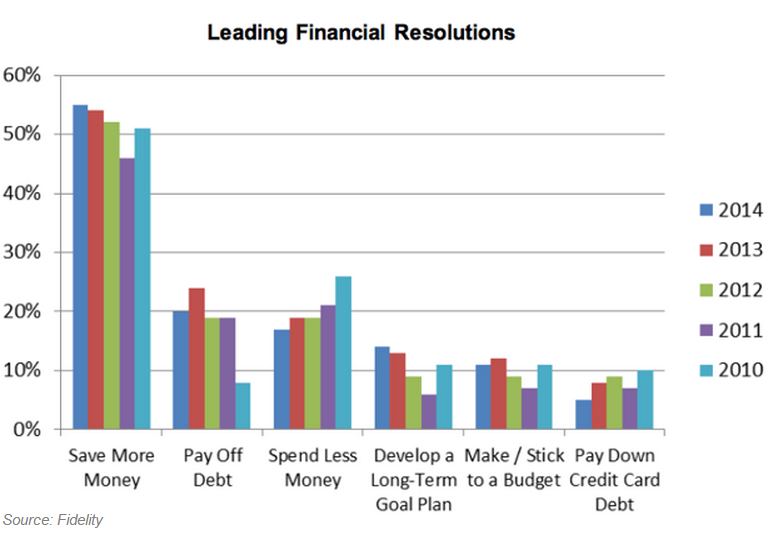
Mandi Woodruff posted the interesting chart below on the leading New Year’s financial resolutions for the past few years. Encouragingly, “develop a plan to reach longer-term goals” is a popular choice, increasing to 14 percent. This is a more than twofold increase since 2011, when it was at a single-digit low of 6 percent.

Need help keeping and tracking your resolutions? Contact us!

Don’t Drop the Ball on Your 2015 Financial Resolutions


Savings-Money


More Money Lessons from “Downton Abbey”

  • January 29, 2015/
  • Posted By : admin/
  • 0 comments /
  • Under : Seeking Prudent Advice

downton-abbeyWe’re big fans of “Downton Abbey”, the television show that follows an aristocratic British family in the early decades of the 20th century.

Over the five seasons that the show has graced PBS’ “Masterpiece”, a number of money lessons have been showcased — mostly what NOT to do!

For example, don’t bet the family fortune on a railroad thousands of miles away (i.e., massive lack of diversification). A professional advisor working in concert with the Earl of Grantham probably would have prevented him from concentrating so much capital in a Canadian railway!

Downton’s money lessons include financial and estate-planning disasters, bad investments, messy trusts, and inadequate business succession plans.

Here are some key takeaways and tie-ins:

  • Spell out control and ownership when passing the baton of a family company
    (the generational transfer of Downton Abbey from Robert to Matthew)
  • Use trusts to protect the family fortune
    (to protect Robert Crawley’s from his own poor decisions)
  • Make a will before giving birth
    (think of Matthew Crawley’s untimely demise)
  • Set up a medical directive
    (the terrible struggle of how to handle Sybil in childbirth)

We can’t wait for more Dowton Abbey and money lessons as season 5 continues!


Best Illustration of Bull & Bear Markets

  • January 22, 2015/
  • Posted By : admin/
  • 0 comments /
  • Under : Market Outlook, Performance

bull-bear-chartThis is the best illustration we’ve ever seen of history’s bull and bear markets.  Blue illustrates past bull markets’ durations and returns (total and annualized).  Red illustrates the bear markets.  This was published in May 2014 so the current bull market is actually pushing 69 months.

Some key takeaways:

  1. There’s a lot more blue than red meaning stocks tend to spend more time going up in value than going down.
  2. The current bull market might feel long but by historical standards, the length and strength of this bull is not exceptional

Source: BI


Investing Priorities

  • January 15, 2015/
  • Posted By : admin/
  • 0 comments /
  • Under : Best Practices, Uncategorised

keep-calm-and-set-your-prioritiesThe general rule of thumb for investing priorities is:

  1. Invest in your company 401(k) plan up to the match
  2. Pay off short-term, non-tax-deductible debt (e.g., credit card, car loan)
  3. Establish an emergency fund; 6-12 months of living expenses is a good guidepost
  4. Put the maximum allowable amount in a Roth IRA (if eligible)
  5. Put the maximum allowable amount in your company 401(k)
  6. Invest the remainder in taxable accounts
  7. Pay down tax-deductible debt (e.g., home mortgage)


Source: Vanguard


Morgan Stanley Advisor Leaks Data for 350,000 Clients

  • January 8, 2015/
  • Posted By : admin/
  • 0 comments /
  • Under : Scams & Schemes, Seeking Prudent Advice

Security concept: Lock on digital screenMorgan Stanley financial advisor Galen Marsh downloaded personal and sensitive account data for 350,000 clients of the firm.  Essentially none of these clients were his own. A few weeks ago in December 2014, these data started showing up on Pastebin, a website popular with data thieves and other illegal operators.  The anonymous data leaker offered to trade more data in exchange for a payoff in virtual currency.  Morgan Stanley detected the breach, subsequently fired the 30-year-old advisor and the FBI has opened an investigation.

One startling aspect of this data breach is the seemingly weak information security at Morgan Stanley.  One of the basic tenets of this space is “access control” — each employee’s access should be restricted to the data he or she needs to operate.  In this case, Mr. Marsh should have had access to only the handful of clients that he supported, not 350,000!

Marsh admitted to downloading data for 350,000 clients but denies posting it online.  Morgan Stanley is trying to understand how Marsh transferred the data offsite.

In response to this breach, Morgan Stanley reportedly tightened security to its client database, hired an outside call center to handle the surge of inbound calls from clients concerned about the breach, and is offering credit and identify theft services to impacted parties.

Source: WSJ


Stock Market’s Merry Performance Over Time

  • December 25, 2014/
  • Posted By : admin/
  • 0 comments /
  • Under : Performance

stocks-christmas-tree

Above is Carter Braxton Worth’s seasonal interpretation of the stock market’s history.  Stacking up the stock market’s annual performance going back nearly 200 years can look merry and bright.

Since 1825, the stock market has produced an annual gain 71% of the time, or 134 times, while losing ground just 55 times. A standard distribution chart, which happens to take the shape of a Christmas tree, shows how for most years, the market moves within a range of zero to up 10%.

Source: MarketWatch


Wages Winners and Losers Since 2004

  • December 18, 2014/
  • Posted By : admin/
  • 0 comments /
  • Under : Economy

winners-losers-2014-2004Great decadal snapshot of wage trends published by the Wall Street Journal. “Stagnant wages have become a hot topic in politics and for good reason, if you compare annual average pay from 2004 and 2013, one-third of all U.S. counties have seen their pay decline, when the figures are adjusted for inflation. The biggest winners for wage increases are the counties running down the center of the country many of which have economies based on energy and agriculture.”

Visit this webpage for an interactive version of this map where you can examine the data for individual counties.

Source: WSJ


A to Z of Behavioral Bias

  • December 11, 2014/
  • Posted By : admin/
  • 0 comments /
  • Under : Behavior

guessesAn A to Z list of common behavioral biases with brief descriptions, examples, causes, possible mitigations and suggested further reading courtesy the Psy-Fi Blog. Each of the links below takes you to the relevant post at Psy-Fi, so have fun and think about how they apply to your own investing habits:

A is for Anchoring
B is for Base Rate Neglect
C is for Confirmation Bias
D is for Disposition Effect
E is for Ego Depletion
F is for Framing
G is for Gambler’s Fallacy
H is for Hindsight Bias
I is for Illusion of Control
J is for January Effect
K is for Kruger-Dunning Effect
L is for Loss Aversion
M is for Mental Accounting
N is for Negativity Bias
O is for Overconfidence
P is for Priming
Q is for Quantification Fallacy
R is for Representative Heuristic
S is for Self-Enhancing Transmission Bias
T is for Texas Sharpshooter Effect
U is for Uncertainty
V is for Von Restorff Effect
W is for Winner’s Curse
X is for Xenophobia
Y is for Yawn Effect
Z is for Zero-Risk Bias


Source:
The A to Z of Behavioral Bias (Psy-Fi Blog)


Top 10 Mistakes Made with Beneficiary Designations

  • December 4, 2014/
  • Posted By : admin/
  • 0 comments /
  • Under : Behavior, Best Practices, Retirement

beneficiary form#1 — Not Naming a Beneficiary
By not naming a beneficiary you have most likely guaranteed that the asset will go through probate upon your death.

#2 — Not Designating Contingent Beneficiaries
If your primary beneficiary predeceases or dies at the same time as you, you’re subject to the same consequences as #1

#3 — Failing to Keep Beneficiary Designations Up-to-Date
If you get divorced, it’s essential you immediately review and update all beneficiary designations.

#4 — Naming Minors as Direct Beneficiaries
Trusts are often established to delay the time a survivor receives an asset until they are old enough to make good money decisions.  However, if you designate a minor child as an account’s beneficiary and there’s also a testamentary trust, the designation trumps the trust and the child will receive the assets immediately.

#5 — Naming Special Needs Individuals as Direct Beneficiaries
Naming a “special needs” individual as the direct beneficiary could unintentionally disqualify that individual from receiving his or her valuable governmental benefits.

#6 — Naming Financially Irresponsible Beneficiaries
Often it’s better to create a lifetime “spendthrift trust” to hold the inheritance for the benefit of the individual for his or her lifetime while protecting the assets from creditors.

#7 — Naming Direct Beneficiaries on All Assets Other than Real Estate
Very often real estate will need to go through probate even if there’s a will in place.  This process can take a year or longer during which the estate is responsible for paying for maintenance, taxes, etc.  It’s generally advisable to allow your cash accounts and/or life insurance proceeds to go through probate so the estate will have sufficient funds to support the real estate during probate.

#8 — Naming Multiple Beneficiaries on a Transfer on Death Deed
Avoid doing because all beneficiaries must agree on the realtor, sale price, and maintenance costs until the property is sold.  Getting that type of agreement is very difficult.

#9 — Naming a Child as Co-Owner of a Deposit or Investment Account
Aging parents will sometimes add a trusted adult child as the co-owner of his or her bank account.  Avoid this because it can create complicated issues around gifting, creditor issues,  and final expenses.

#10 — Naming One Child as the Sole Beneficiary of a Life Insurance Policy or Deposit Account
A parent with multiple adult children should avoid doing this because it can create a situation very similar to #9.

Source: AAII


« First‹ Prev31323334353637Next ›Last »
Recent Posts
  • GRB 250314A
    Hidden Insurance Gaps That Threaten Your Wealth December 11,2025
  • S106
    Your Parents’ Money: A Guide to Financial Caregiving November 27,2025
  • SNR 0509-67.5
    80% Rule for Retirement Income: Myth or Reality? November 13,2025
  • Tarantula Nebula
    Tax Moves to Make Before 2026 October 30,2025
  • Bull's Eye Galaxy
    Unexpected Risks That Could Derail Your Retirement October 16,2025
Archives
  • December 2025
  • November 2025
  • October 2025
  • September 2025
  • August 2025
  • July 2025
  • June 2025
  • May 2025
  • April 2025
  • March 2025
  • February 2025
  • January 2025
  • December 2024
  • November 2024
  • October 2024
  • September 2024
  • August 2024
  • July 2024
  • June 2024
  • May 2024
  • April 2024
  • March 2024
  • February 2024
  • January 2024
  • December 2023
  • November 2023
  • October 2023
  • September 2023
  • August 2023
  • June 2023
  • May 2023
  • April 2023
  • March 2023
  • February 2023
  • January 2023
  • November 2022
  • October 2022
  • September 2022
  • August 2022
  • July 2022
  • May 2022
  • April 2022
  • March 2022
  • February 2022
  • December 2021
  • October 2021
  • September 2021
  • August 2021
  • July 2021
  • June 2021
  • May 2021
  • April 2021
  • March 2021
  • February 2021
  • January 2021
  • December 2020
  • November 2020
  • October 2020
  • September 2020
  • August 2020
  • July 2020
  • June 2020
  • May 2020
  • April 2020
  • March 2020
  • November 2019
  • October 2019
  • June 2019
  • May 2019
  • April 2019
  • March 2019
  • February 2019
  • January 2019
  • December 2018
  • November 2018
  • October 2018
  • September 2018
  • August 2018
  • July 2018
  • June 2018
  • May 2018
  • April 2018
  • March 2018
  • February 2018
  • January 2018
  • December 2017
  • November 2017
  • October 2017
  • September 2017
  • August 2017
  • July 2017
  • June 2017
  • May 2017
  • April 2017
  • March 2017
  • February 2017
  • January 2017
  • December 2016
  • November 2016
  • October 2016
  • September 2016
  • August 2016
  • July 2016
  • June 2016
  • May 2016
  • April 2016
  • March 2016
  • February 2016
  • January 2016
  • December 2015
  • November 2015
  • October 2015
  • September 2015
  • August 2015
  • July 2015
  • June 2015
  • May 2015
  • April 2015
  • March 2015
  • February 2015
  • January 2015
  • December 2014
  • November 2014
  • October 2014
  • September 2014
  • August 2014
  • July 2014
  • June 2014
  • May 2014
  • April 2014
  • March 2014
  • February 2014
  • January 2014
  • December 2013
  • November 2013
  • October 2013
  • September 2013
  • August 2013
  • July 2013
  • June 2013
  • May 2013
  • April 2013
  • March 2013
  • February 2013
  • January 2013
  • December 2012
  • November 2012
  • October 2012
  • September 2012
  • August 2012
  • July 2012
  • June 2012
  • May 2012
  • April 2012
  • March 2012
  • February 2012
  • January 2012
  • December 2011
  • November 2011
  • October 2011
  • September 2011
  • August 2011
  • July 2011
  • June 2011
  • May 2011
  • April 2011
  • March 2011
  • February 2011
  • January 2011
  • November 2010
  • October 2010
  • September 2010
  • August 2010
Categories
  • 401(k)
  • Annuities
  • Behavior
  • Best Practices
  • Bonds
  • Charitable Donations
  • Economy
  • Fees
  • Fiduciary
  • Financial Planning
  • Investing 101
  • Live Well
  • Market Outlook
  • Mutual Funds
  • NorthStar
  • Performance
  • Personal Finance
  • Planning
  • Retirement
  • Saving Money
  • Scams & Schemes
  • Seeking Prudent Advice
  • Tax Planning
  • Uncategorised
  • Uncategorized
  • Weekly Market Review
ABOUT US

We are a fee-only, independent fiduciary advisor. Our allegiance rests solely with our clients and their best interests. We are headquartered in Charlotte, North Carolina and serve client families across the nation.


CLIENT TOOLS
CONTACT
  • (704) 350-5028
  • info@nstarcapital.com
  • 521 East Blvd, Charlotte, NC 28203
    (by appointment only)
  • fax: (704) 626-3462
RETIREMENT ISN’T ROCKET SCIENCE PODCAST
  • GRB 250314A
    Hidden Insurance Gaps That Threaten Your Wealth December 11,2025
  • S106
    Your Parents’ Money: A Guide to Financial Caregiving November 27,2025
  • SNR 0509-67.5
    80% Rule for Retirement Income: Myth or Reality? November 13,2025
Nothing on this website constitutes either the provision of investment advice or solicitation to provide investment advice.
Investment advice can only be provided through a formal investment advisory relationship.