NorthStar Capital AdvisorsNorthStar Capital AdvisorsNorthStar Capital AdvisorsNorthStar Capital Advisors
Start Here
  • How We Help
  • Who We Serve
  • Who We Are
  • Fiduciary
  • Podcast
  • Start Here
  • How We Help
  • Who We Serve
  • Who We Are
  • Fiduciary
  • Podcast
  • Start Here

Chasing Past Performance is Expensive

  • September 18, 2014/
  • Posted By : admin/
  • 0 comments /
  • Under : Behavior, Best Practices, Mutual Funds, Performance, Seeking Prudent Advice

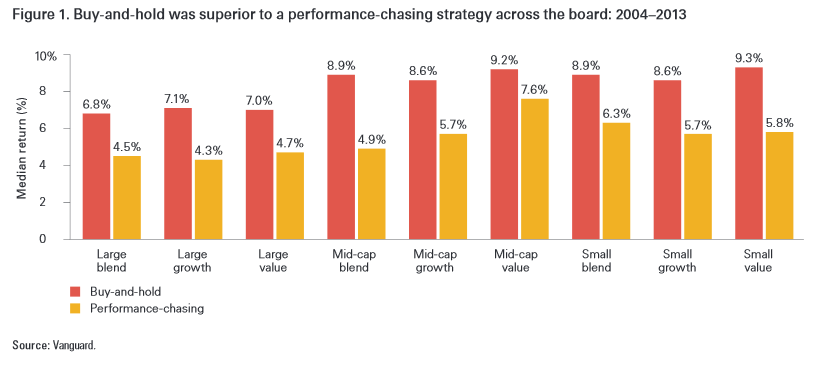
vanguard-chasingA new study demonstrates that chasing the hot mutual fund is an inferior investing strategy compared to good, old-fashioned buy and hold.

Vanguard analyzed a decade of data ending December 31, 2013 across nine asset classes.  In every case the investor would have been significantly better off just sticking with the index.  On average the indexes generated 50% higher returns than the performance-chasing strategy!

Buy and hold may not be perfect, but it can be a lot better than flitting from mutual fund to mutual fund.



Regulators Urge Small Investors to Avoid Non-Traded REITs

  • September 4, 2014/
  • Posted By : admin/
  • 0 comments /
  • Under : Scams & Schemes, Seeking Prudent Advice

real-estateREITs stands for Real Estate Investment Trusts.  REITs sell like a stock on the major exchanges and invests in real estate directly, either through properties or mortgages. REITs receive special tax considerations and typically offer investors high yields, as well as a highly liquid method of investing in real estate.

Real Estate is historically a good performing  asset class.  Allocating approximately 10% of your stock portfolio is a generally prudent choice.  However, state regulators are seeing more and more trouble with a certain type of real estate investment: non-traded REITs.

Non-Traded REITs
Unlike normal REITs, non-traded REITs do not trade on a securities exchange.  They have several very significant issues:

  1. Non-traded be can very illiquid.
  2. They can be very difficult or impossible to price on a regular basis.
  3. It can be difficult to exit the investment.
  4. Front-end fees can be as much as 15% (much higher than traded REITs due to the limited secondary market)

Non-traded REITs buy office buildings, stores, and other properties.  They are sold directly to private investors by financial advisors and brokers.

State Securities Regulators Worried
Regulators are concerned that small investors are not fully aware nor understand the risks associated with non-trade REITs.  States are on the verge of adopting new restrictions to protect “mom and pop” investors including:

  1. Limit how much an individual’s net worth could be put into any a single REIT
  2. Limit the ability of REITs to pay dividends immediately after raising new money (to avoid a Ponzi-scheme like dynamic of paying old investors with new investors’ money)

The State of Massachusetts has brought enforcement actions against brokerages for improper sales of non-traded REITs including

  • LPL Financial
  • Ameriprise
  • Commonwealth Financial
  • Lincoln Financial

Source: WSJ


Credit Card Comparison Sites are NOT unbiased

  • August 28, 2014/
  • Posted By : admin/
  • 0 comments /
  • Under : Best Practices, Personal Finance

cardsIf you google “credit card comparison” you’ll get a long list of review websites.  These sites purportedly provide an objective, unbiased analysis for consumers looking for a good credit card.   But if you dig into the fine print, you’ll discovered that very often lenders pay to advertise on those sites!  If fact, credit card providers take a heavy hand in dictating how their cards show up on these sites.

These six websites’ credit card comparison tools show only cards from lenders that pay to advertise:

  • Credit.com
  • CreditDonkey.com
  • CreditSeasame.com
  • FindTheBest.com
  • Mint.com
  • MyRatePlan.com

Many others show mostly advertiser cards and those credit cards receive preferential treatment.

Usually, the card-comparison sites get paid only if consumers start the card application process on the site and the lender approves them for a card.

Buyer (or credit card carrier) be ware!

Source: WSJ


75% of Americans get the Most Important Investing Question WRONG

  • August 21, 2014/
  • Posted By : admin/
  • 0 comments /
  • Under : Bonds, Mutual Funds, Performance, Personal Finance, Seeking Prudent Advice

Powerful observation from Vox.com regarding public perception versus reality when it comes to how to best invest your money:

Which of the following do you think is the best long-term investment?

  1. Real Estate

  2. Gold

  3. Stocks/Mutual Funds

  4. Savings Account

Don’t feel bad if you didn’t get the answer right. You’re in good company.

Recently, Gallup asked Americans what they thought their best investment bet was over the long run. 24 percent of Americans named stocks and mutual funds — but the same share named gold, and even more (30 percent) named real estate. The trend lines are actually positive, as in 2011 a baffling 34 percent of Americans named gold as their top pick:

gallupThere’s a right answer here — and it’s one that about two thirds of respondents who answered the question got wrong. If history is any guide, stocks are the best bet in the long run, and gold and real estate certainly are not.

siegel_returns

Source: Vox.com


Student Debt Linked to Worse Health and Less Wealth

  • August 14, 2014/
  • Posted By : admin/
  • 0 comments /
  • Under : Personal Finance, Seeking Prudent Advice

student-debtThe negative effects of student debt are significant and persistent according to a new Gallop poll.  Those who borrowed more than $25,000 are less likely to enjoy work and are less financially and physically fit than their debt-free peers even 24 years after graduation.

Gallop examined five elements of well-being:

  • Purpose: liking what you do each day and being motivated to achieve your goals
  • Social: having supportive relationships and love in your life
  • Financial: managing your economic life to reduce stress and increase security
  • Community: liking where you live, feeling safe, and having pride in your community
  • Physical: having good health and enough energy to get things done daily

Financial and physical well-being show the strongest relationship with student debt.  Conversely, social well-being appears to have the weakest debt link.

“These results offer a new dimension of how college debt affects the rest of your life and it gives us more cause for concern,” said Brandon Busteed, executive director of Gallup Education.

Source: Gallup


Annual Asset Class Returns

  • August 7, 2014/
  • Posted By : admin/
  • 0 comments /
  • Under : Performance, Seeking Prudent Advice

The table below ranks the best to worst investment returns by asset class over the past 15 years.  CLICK IT FOR A CLOSER LOOK
asset-returnsGreat chart from Novelinvestor:

The chart  shows several issues investors struggle with all the time. It’s difficult to pick the best performing investment year after year, yet for many investors it’s an annual event. They look for an encore, picking the best asset class last year with the hope of a repeat performance. Yet, betting on last year’s winner rarely works out.

Assets at the top of the chart one year could be at the bottom the next, and vice versa. Much of this is due to reversion to the mean. But over the long-term, those big swings even out.  The chart shows annual returns for eight asset classes against a diversified portfolio. Diversification works to smooth out those big swings in the short-term. While you’ll never get the biggest gains of any year, you avoid the huge losses.


Start Early to Raise Money-Savvy Kids

  • July 31, 2014/
  • Posted By : admin/
  • 0 comments /
  • Under : Saving Money

girlmoneyThree out of four American teens can’t decipher a pay stub. The financial literacy of American 15-year-olds is marginally average in an international, widely-cited assessment.

Since only 17 states require a high-school personal-finance class, the burden of teaching our kids about money falls on us parents.

A comprehensive review of the academic literature shows that basic financial habits are generally set by age 7.  Children as young as 3 can comprehend basic financial concepts like value, exchange, and choice.

Some parents are terrified by the notion of teaching their kids about money because they feel their own knowledge of the subject is thin.  But you don’t need to be a Certified Financial Planner to show your kids the advantage of saving a dime out of every dollar, comparing prices, and avoiding high-interest credit card debt.

MoneyAsYouGrow.Org
The website MoneyAsYouGrow.org is a fantastic resource that pulls together the best research and educational materials available into a manageable list of 20 financial rules of thumb.  These pearls of wisdom are organized by age and include activities to bolster the learning process.

So if you’re a parent or grandparent, seize the opportunity to shape your child’s future by nurturing their financial savvy.

The first step is to start talking to your kids about money.  So grab your talking points from MoneyAsYouGrow.org and get to it!


Source: WSJ


Supreme Court: No Bankruptcy Protection for Inherited IRAs

  • July 23, 2014/
  • Posted By : admin/
  • 0 comments /
  • Under : Retirement

supreme-courtIn June the U.S. Supreme Court issued a unanimous ruling stating that inherited IRAs are not protected from creditors under the bankruptcy code.  This decision does not apply to any other type of individual retirement accounts.

The Supreme Court case centered on an inherited, non-spousal IRA.  Heidi Heffron-Clark inherited her mother’s traditional IRA in 2001.  Heffron-Clark subsequently declared bankruptcy in 2010.

The Court acknowledged there is an exemption in the bankruptcy code for retirement accounts.  More specifically, the code gives protection to “retirement funds” that are “sums of money set aside for the day an individual stops working”.

The funds set aside in an inherited IRAs are not considered retirement savings because of three legal properties:

  1. Additional funds can never be contributed to an inherited IRA
  2. Beneficiaries of inherited IRAs are required to either withdraw the entire balance within 5 years after the owner’s death or take minimum withdrawals every year
  3. The owner of the an inherited IRA can make withdrawals at any time, whereas traditional and Roth IRA owners incur a penalty for withdrawing before age 59 1/2

Justice Sonia Sotomayor, writing for the court, highlighted that the bankruptcy protections given to traditional and Roth IRAs are intended to protect the debtor’s needs in retirement.  Affording the same protection to inherited IRAs would give debtors essentially a “free pass” as the funds could be used to purchase “a vacation home or sports car immediately after her bankruptcy proceedings are complete.”

Source:
“Clark et ux v. Rameker, Trustee, et al,” U.S. Surpeme Court, No. 13-299 (June 12, 2014)


Global Retirement Dilemma

  • July 17, 2014/
  • Posted By : admin/
  • 0 comments /
  • Under : Retirement

click for large viewglobal-retirement

Source: Bloomberg


What Kind of Investor Are You?

  • July 10, 2014/
  • Posted By : admin/
  • 0 comments /
  • Under : Behavior, Seeking Prudent Advice

question-mark

What kind of investor are you?  According to author William Bernstein, there are three broad groups of investors segregated by behavior:

Group 1: The average small investor, who does not have a coherent asset-allocation strategy and who owns a chaotic mix of mutual funds and/or individual securities, often recommended to him or her by a broker or advisor. He or she tends to buy near bull market peaks and sell near bear market troughs.

Group 2: The more sophisticated investor, who does have a reasonable-seeming asset-allocation strategy and who will buy when prices fall a bit (“buying the dips”), but who falls victim to the aircraft simulator/actual crash paradigm, loses his or her nerve, and bails when real trouble roils the markets. You may not think you belong in this group, but unless you’ve tested yourself and passed during the 2008–2009 bear market, you really can’t tell.

Group 3: Those who do have a coherent strategy and can stick to it. Three things separate this group from Group 2: first, a realistic appraisal of their true, under-fire risk tolerance; second, an allocation to risky assets low enough, or a savings rate high enough, to allow them to financially and emotionally weather a severe downturn; and third, an appreciation of market history, particularly the carnage inflicted by the 1929–1932 bear market. In other words, this elite group possesses not only patience, cash, and courage, but also the historical knowledge informing them that at several points in their investing career, all three will prove necessary. Finally, they have the foresight to plan for those eventualities.

“Job one for the investor, then, is to learn as best she can, to ignore the day-to-day and year-to-year speculative return in order to earn the fundamental return.” – William Bernstein

Source: Rational Expectations: Asset Allocation for Investing Adults


« First‹ Prev34353637383940Next ›Last »
Recent Posts
  • GRB 250314A
    Hidden Insurance Gaps That Threaten Your Wealth December 11,2025
  • S106
    Your Parents’ Money: A Guide to Financial Caregiving November 27,2025
  • SNR 0509-67.5
    80% Rule for Retirement Income: Myth or Reality? November 13,2025
  • Tarantula Nebula
    Tax Moves to Make Before 2026 October 30,2025
  • Bull's Eye Galaxy
    Unexpected Risks That Could Derail Your Retirement October 16,2025
Archives
  • December 2025
  • November 2025
  • October 2025
  • September 2025
  • August 2025
  • July 2025
  • June 2025
  • May 2025
  • April 2025
  • March 2025
  • February 2025
  • January 2025
  • December 2024
  • November 2024
  • October 2024
  • September 2024
  • August 2024
  • July 2024
  • June 2024
  • May 2024
  • April 2024
  • March 2024
  • February 2024
  • January 2024
  • December 2023
  • November 2023
  • October 2023
  • September 2023
  • August 2023
  • June 2023
  • May 2023
  • April 2023
  • March 2023
  • February 2023
  • January 2023
  • November 2022
  • October 2022
  • September 2022
  • August 2022
  • July 2022
  • May 2022
  • April 2022
  • March 2022
  • February 2022
  • December 2021
  • October 2021
  • September 2021
  • August 2021
  • July 2021
  • June 2021
  • May 2021
  • April 2021
  • March 2021
  • February 2021
  • January 2021
  • December 2020
  • November 2020
  • October 2020
  • September 2020
  • August 2020
  • July 2020
  • June 2020
  • May 2020
  • April 2020
  • March 2020
  • November 2019
  • October 2019
  • June 2019
  • May 2019
  • April 2019
  • March 2019
  • February 2019
  • January 2019
  • December 2018
  • November 2018
  • October 2018
  • September 2018
  • August 2018
  • July 2018
  • June 2018
  • May 2018
  • April 2018
  • March 2018
  • February 2018
  • January 2018
  • December 2017
  • November 2017
  • October 2017
  • September 2017
  • August 2017
  • July 2017
  • June 2017
  • May 2017
  • April 2017
  • March 2017
  • February 2017
  • January 2017
  • December 2016
  • November 2016
  • October 2016
  • September 2016
  • August 2016
  • July 2016
  • June 2016
  • May 2016
  • April 2016
  • March 2016
  • February 2016
  • January 2016
  • December 2015
  • November 2015
  • October 2015
  • September 2015
  • August 2015
  • July 2015
  • June 2015
  • May 2015
  • April 2015
  • March 2015
  • February 2015
  • January 2015
  • December 2014
  • November 2014
  • October 2014
  • September 2014
  • August 2014
  • July 2014
  • June 2014
  • May 2014
  • April 2014
  • March 2014
  • February 2014
  • January 2014
  • December 2013
  • November 2013
  • October 2013
  • September 2013
  • August 2013
  • July 2013
  • June 2013
  • May 2013
  • April 2013
  • March 2013
  • February 2013
  • January 2013
  • December 2012
  • November 2012
  • October 2012
  • September 2012
  • August 2012
  • July 2012
  • June 2012
  • May 2012
  • April 2012
  • March 2012
  • February 2012
  • January 2012
  • December 2011
  • November 2011
  • October 2011
  • September 2011
  • August 2011
  • July 2011
  • June 2011
  • May 2011
  • April 2011
  • March 2011
  • February 2011
  • January 2011
  • November 2010
  • October 2010
  • September 2010
  • August 2010
Categories
  • 401(k)
  • Annuities
  • Behavior
  • Best Practices
  • Bonds
  • Charitable Donations
  • Economy
  • Fees
  • Fiduciary
  • Financial Planning
  • Investing 101
  • Live Well
  • Market Outlook
  • Mutual Funds
  • NorthStar
  • Performance
  • Personal Finance
  • Planning
  • Retirement
  • Saving Money
  • Scams & Schemes
  • Seeking Prudent Advice
  • Tax Planning
  • Uncategorised
  • Uncategorized
  • Weekly Market Review
ABOUT US

We are a fee-only, independent fiduciary advisor. Our allegiance rests solely with our clients and their best interests. We are headquartered in Charlotte, North Carolina and serve client families across the nation.


CLIENT TOOLS
CONTACT
  • (704) 350-5028
  • info@nstarcapital.com
  • 521 East Blvd, Charlotte, NC 28203
    (by appointment only)
  • fax: (704) 626-3462
RETIREMENT ISN’T ROCKET SCIENCE PODCAST
  • GRB 250314A
    Hidden Insurance Gaps That Threaten Your Wealth December 11,2025
  • S106
    Your Parents’ Money: A Guide to Financial Caregiving November 27,2025
  • SNR 0509-67.5
    80% Rule for Retirement Income: Myth or Reality? November 13,2025
Nothing on this website constitutes either the provision of investment advice or solicitation to provide investment advice.
Investment advice can only be provided through a formal investment advisory relationship.