
NorthStar Capital AdvisorsNorthStar Capital AdvisorsNorthStar Capital AdvisorsNorthStar Capital Advisors
Start Here
  • How We Help
  • Who We Serve
  • Who We Are
  • Fiduciary
  • Podcast
  • Start Here
  • How We Help
  • Who We Serve
  • Who We Are
  • Fiduciary
  • Podcast
  • Start Here

Code Red! 8 Ways to Permanently Wipe Out Your Retirement Savings

  • December 5, 2013/
  • Posted By : admin/
  • 0 comments /
  • Under : Behavior, Personal Finance, Retirement, Saving Money, Scams & Schemes, Seeking Prudent Advice

code-redDana Anspach at MarketWatch recently wrote about 8 financially devastating mistakes (aka “Code Reds”) that must be avoided:

1. Believe in a stock
The company you work for is doing well. You understand the potential of the business. You should own a lot of company stock. After all, it shows your level of commitment, right? 
WRONG! CODE RED!
You can lock in lifestyle by taking risk off the table. If trusted advisers are telling you to reduce risk, listen. You can’t take your “belief” in your company stock to the bank. Owning a lot of company stock doesn’t demonstrate a commitment to your company; it demonstrates a lack of commitment to your own personal financial planning.

2. Get reeled into real estate
Rental real estate is a good way to build wealth with someone else’s money, isn’t it? I mean, that’s what the infomercials say.
WRONG! CODE RED!
Investing in real estate is a profession in and of itself. With real estate prices on the rise again, don’t get reeled in with the lure of easy passive income. It isn’t as easy as it looks.

3. Follow a Tip
An opportunity to double your money is an investment opportunity worth pursuing. It could change your life, right?
WRONG! CODE RED!
Tips are great for your waiter or waitress. But where you family’s future is concerned, avoid the tips, and stick with a disciplined and diversified approach.

4. Change lanes — every year
Smart investors watch the market and frequently move money into the latest high performing investment, right?
WRONG! CODE RED!
You’ve probably noticed if you constantly changes lanes on a backed up highway, always trying to inch ahead, you usually end up farther behind. Driving this way isn’t effective; investing this way isn’t effective either. Pick a disciplined strategy and stick to it. Jumping from investment to investment is only going to slow you down.

5. Play the currency cards
Experts can deliver higher returns, right? Find someone who knows how to trade, and you’ll be set.
WRONG! CODE RED!
If experts could generate such high returns, why would they need your business? Don’t play the currency cards, the expert cards, or fall for any kind of outlandish promises. I’ve yet to see one of these programs work the way it was marketed.

6. Follow your ego
Better investments are available to those with more money, right? If you get the opportunity to participate in something exclusive, it is likely to deliver better returns.
WRONG! CODE RED!
If someone appeals to your ego, walk away. When it comes to investing, the only thing I’ve seen egos do is help someone lose money.

7. Follow their ego
You can trust prestigious people in your community. That’s why you should do business with them, right?
WRONG! CODE RED!
Checks and balances are good in government and in investing. One way to make sure checks and balances are in place is to work with an investment adviser that uses a third party custodian. The third party custodian sends account statements directly to you. The investment adviser can make changes in your account, but the transactions are reported to you directly by the custodian, who isn’t and should not be affiliated with the investment adviser.

8. Leverage up
Borrowing at low interest rates and investing in high growth assets is an excellent way to accumulate wealth, isn’t it?
WRONG! CODE RED!
Think twice before borrowing to invest. It causes ruin more often than it causes riches.

Visit MarketWatch to read Anspach’s full article.


Thanksgiving Dinner Costs Less in 2013

  • November 27, 2013/
  • Posted By : admin/
  • 0 comments /
  • Under : Uncategorized

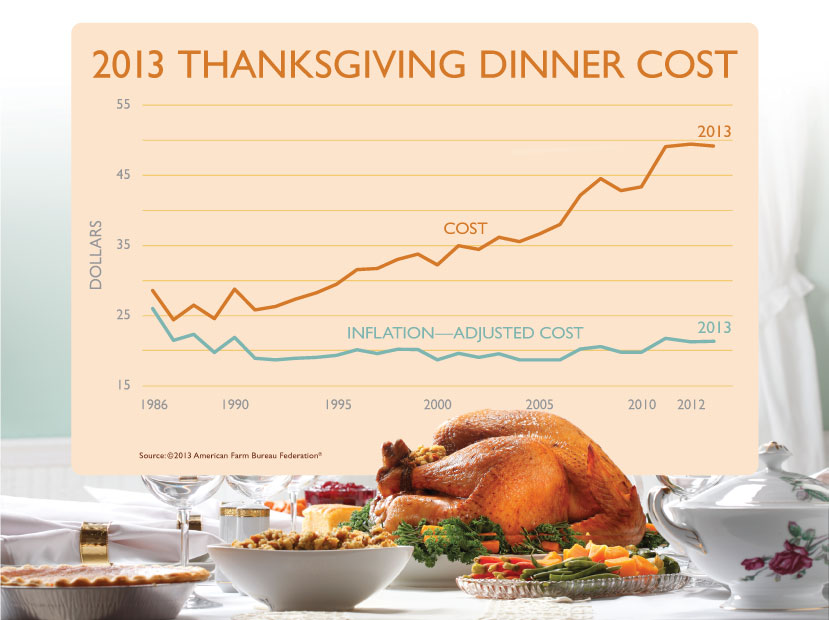
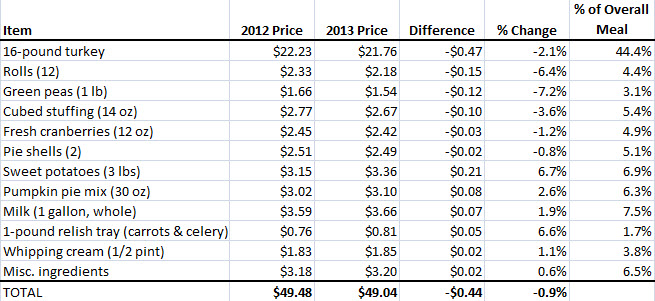
turkey-2013aThis year’s turkey dinner won’t cost you any more than last year’s.  The average cost of a classic Thanksgiving Dinner for 10 people is $49.04 according to the American Farm Bureau Federation’s survey.  That’s a 44-cent or 0.9% price decrease from last year.

The bird soaks up the lion’s share of the budget at 44% of the meal’s cost. The 16-pound turkey came in at $21.76 this year or $1.36 per pound.  The biggest year-over-year change on a percentage basis were the sweet potatos whose cost increased 6.7%.  Green peas contributed the biggest percentage drop at -7.2%.

The average cost of a turkey dinner has hovered around $49 since 2011.  The relative price stability of the turkey index mirrors the government’s Consumer Price Index for food eaten at home which increased only 1% compared to last year.

Happy Thanksgiving!

turkey-2013

Click on the image for a high resolution version. Data source: AFBF

Source: AFBF


Charity Navigator — The Smart Way to Give

  • November 21, 2013/
  • Posted By : admin/
  • 0 comments /
  • Under : Charitable Donations, Scams & Schemes, Seeking Prudent Advice

charity-navigator‘Tis the season for giving, but how do you know if you’re contributing to a reputable organization that will make the best use of your donation?

Charity Navigator (charitynavitagor.org) features a rating system of 1 to 4 stars for dozens of charitable organizations.  This non-profit provides key guidance on where it’s best to give and how these charities utilize the money that you give them.

A four-star charity has the following characteristics:

  • it excels at its financial health
  • spends most of its money on its charitable programs (not administration or fundraising)
  • completes an annual financial audit
  • guarantees donors it won’t sell their names to outside parties (i.e., it protects its donors privacy and respects their time)

The best way to donate is to give directly to the charity through their website.

The worst is donating to “cold calls” from a telemarketing firm.  The middleman typically keeps 80% to 90% of your contribution and shamefully little actually reaches those in need.  Also, avoid appeals delivered via social media because you don’t know who is behind them.

Sources:
Charity Navigator
NPR


401(k) Balances Hits Record High

  • November 14, 2013/
  • Posted By : admin/
  • 0 comments /
  • Under : 401(k), Retirement

401kgoldMultiple years of strong stock market performance coupled with disciplined savings has propelled 401(k) accounts to a record high.

According to Fidelity Investments, the nation’s largest 401(k) provider, the average 401(k) balance reached $84,000 during the third quarter of 2013, up 11% from $75,900 the previous year. This is overall average is based on 12.6 million accounts.

401(k) savers that have been actively contributing to their accounts over the past 10 years saw their average balance grow $223,100, up 19.6% during the 12 months that ended in June.

Fidelity also reported that fewer 401(k) participants are relying on “do-it-yourself” investing and instead are moving toward managed accounts and target-date funds.  Managed accounts provide individualized investment advice.


Your Flex Spending Account Might Allow a $500 Rollover

  • November 7, 2013/
  • Posted By : admin/
  • 0 comments /
  • Under : Saving Money

500dollarsThe federal government has relaxed rules governing flexible spending accounts or FSAs.  Starting in 2014, consumers may be allowed to roll over as much $500 in unused funds each year.

A flexible spending account is a great way to save money with healthcare-related expenses by using pre-tax money.  However, one of the drawbacks up until now has been the “use-it-or-lose-it” nature of these accounts.  At the beginning of each year you must estimate your eligible medical expenses and set aside that amount in your FSA account.  Prior to the new rules, you would lose any funds remaining in your FSA account at the end of the year, though often there is a grace period to use those down.

Under the new FSA rules your employer can choose to offer you the option of up to a $500 rollover of unused funds OR a two and a half month grace period, but not both.


Social Security Benefits To Increase 1.5% in 2014

  • October 31, 2013/
  • Posted By : admin/
  • 0 comments /
  • Under : Retirement

social-securityThe federal government announced Wednesday that the social security benefits for almost 63 million retirees and disabled people will increase by 1.5% next year.

This will be one of the smallest annual increases since automatic cost-of-living adjustments (COLA) began in 1975.  The sluggish U.S economic recovery has kept inflation in check and limited businesses’ ability to raise prices of goods and services.

The COLA is calculated by comparing consumer prices in July, August and September each year to prices in the same three months from the previous year. If prices go up over the course of the year, benefits go up, starting with payments delivered in January.

The benefit increase for 2014 comes after a 1.7% gain for 2013. Besides 2010 and 2011, when there were no increases, next year’s rise will be the smallest since 2003, when benefits went up by 1.4%.

Social Security pays retired workers an average of $1,272 a month. A 1.5% raise comes to about $19.


Your Projected Medical Costs in Retirement Will Surprise You!

  • October 24, 2013/
  • Posted By : admin/
  • 0 comments /
  • Under : Retirement, Uncategorized

101413-furute-of-retirement-illustration
It’s important to be aware of what healthcare costs will look like in your future retirement budget.

The following statistics effectively guarantee the need to emphasize portfolio growth as opposed to income for many investors:

According to an AARP study released early this year, titled “What are the Retirement Prospects of Middle-Class Americans,” rising out-of-pocket medical costs are the prime factor threatening retirement security.

The report notes that median out-of-pocket medical expenses for 70-year-olds currently come to $2,800, or 8.2% of annual income.

For middle-income workers aged 45 to 54 in 2012, that figure should rise to $5,600, or 15.3% of income, when they reach 70,

while for those between ages 25 and 34, those expenses are likely to rise to $11,000, or 20% of income.

With those rising medical outlays, the AARP study concluded “future retirees are less likely than current retirees to maintain their standard of living during retirement.”

The takeaway for this is that the real risk for many future retirees will  not be volatility – it will be the real threat of running out of money before running out of life.  To combat this, it’s prudent to build up your pre-retirement savings and assure you have sufficient stock holdings even during retirement.

Source:
Not Your Father’s Retirement


Best & Worst Investing Advice During the Government Shutdown

  • October 17, 2013/
  • Posted By : admin/
  • 0 comments /
  • Under : Seeking Prudent Advice

closedDan Solin wrote a good piece this week at the Huffington Post.  Here are some key excerpts.

This is a busy time for financial journalists and advisers. The government shutdown and the looming prospect of an unprecedented default by the U.S. Treasury in meeting its obligations have rattled investors.

When looking for advice about investment-related subjects, it’s important to keep in mind the different obligations of the person providing it. Here’s a summary:

Brokers have an obligation to provide advice that’s merely “suitable” for their clients. They don’t have to act solely in the best interest of their clients. For example, a proprietary mutual fund may be “suitable,” even though it has a much higher expense ratio (management fee) and a lower expected return than a comparable, less expensive index fund.

Registered Investment Adviser firms have a fiduciary duty to always act in the best interest of their clients. In the example discussed above, advisers with an RIA firm would violate their fiduciary duty if they recommended the proprietary fund.

The financial media have no legal obligation to viewers or readers other than what is imposed by common law (such as laws relating to libel, slander and defamation).

The financial media’s lack of a high legal standard explains the wide swing in the quality of the information it disseminates.

Here’s the underlying problem. Many investors are unable to distinguish between sound, evidence-based advice disseminated by Swedroe (and others such as Carl Richards, Jason Zweig, John Wasik, William Bernstein and John Bogle) and the wacky entertainment provided by Cramer. Especially in times of crises, those who succumb to Cramer’s nonsense may find their retirement dreams seriously affected. For CNBC and Cramer, it’s apparently of little concern, as long as those advertising revenues keep rolling in.

Read more of this great short article here.


“Cockroaching” — 5,000 Stockbrokers from Expelled Firms Still Selling Securities

  • October 10, 2013/
  • Posted By : admin/
  • 0 comments /
  • Under : Scams & Schemes, Seeking Prudent Advice

cockroach_exterminator_450More than 5,000 stockbrokers who were still licensed to sell securities earlier this year after working for one or more firms that regulators expelled between 2005 and 2012, according to The Wall Street Journal.

The pattern of brokers moving from one problem firm to another, according to a former broker, is sometimes called “cockroaching.”

The Journal’s analysis reveals some of the nationwide migratory patterns of brokers associated with firms having troubled regulatory records. These brokers often remain in the industry after working at firms expelled by regulators, in some cases after the brokers accrued numerous arbitration claims or declared multiple bankruptcies.

58% of brokers from at least two expelled firms have at least one black mark on their records.  This is much higher than the 13% average for all brokers.

Always check the background of any financial professional before doing business with him or her.  It takes only a few minutes and can save you a lot of trouble.

Research brokers or brokerage firms here:
http://brokercheck.finra.org/Search/Search.aspx

Research investment advisors here:
http://www.adviserinfo.sec.gov/IAPD/Content/Search/iapd_Search.aspx


Women Choosing Lower-Paying Jobs

  • October 3, 2013/
  • Posted By : admin/
  • 0 comments /
  • Under : Economy, Personal Finance

Three weeks ago we wrote about The Most and Least Lucrative College Majors.  An interesting aspect on this topic is the propensity for women to select lower-paying jobs. NPR’s Lisa Chow covered the story recently (Why Women (Like Me) Choose Lower-Paying Jobs).  women-careers

Women are overrepresented among majors that don’t pay very well (psychology, art, comparative literature), and underrepresented in lots of lucrative majors (most fields in engineering).


« First‹ Prev38394041424344Next ›Last »
Recent Posts
  • GRB 250314A
    Hidden Insurance Gaps That Threaten Your Wealth December 11,2025
  • S106
    Your Parents’ Money: A Guide to Financial Caregiving November 27,2025
  • SNR 0509-67.5
    80% Rule for Retirement Income: Myth or Reality? November 13,2025
  • Tarantula Nebula
    Tax Moves to Make Before 2026 October 30,2025
  • Bull's Eye Galaxy
    Unexpected Risks That Could Derail Your Retirement October 16,2025
Archives
  • December 2025
  • November 2025
  • October 2025
  • September 2025
  • August 2025
  • July 2025
  • June 2025
  • May 2025
  • April 2025
  • March 2025
  • February 2025
  • January 2025
  • December 2024
  • November 2024
  • October 2024
  • September 2024
  • August 2024
  • July 2024
  • June 2024
  • May 2024
  • April 2024
  • March 2024
  • February 2024
  • January 2024
  • December 2023
  • November 2023
  • October 2023
  • September 2023
  • August 2023
  • June 2023
  • May 2023
  • April 2023
  • March 2023
  • February 2023
  • January 2023
  • November 2022
  • October 2022
  • September 2022
  • August 2022
  • July 2022
  • May 2022
  • April 2022
  • March 2022
  • February 2022
  • December 2021
  • October 2021
  • September 2021
  • August 2021
  • July 2021
  • June 2021
  • May 2021
  • April 2021
  • March 2021
  • February 2021
  • January 2021
  • December 2020
  • November 2020
  • October 2020
  • September 2020
  • August 2020
  • July 2020
  • June 2020
  • May 2020
  • April 2020
  • March 2020
  • November 2019
  • October 2019
  • June 2019
  • May 2019
  • April 2019
  • March 2019
  • February 2019
  • January 2019
  • December 2018
  • November 2018
  • October 2018
  • September 2018
  • August 2018
  • July 2018
  • June 2018
  • May 2018
  • April 2018
  • March 2018
  • February 2018
  • January 2018
  • December 2017
  • November 2017
  • October 2017
  • September 2017
  • August 2017
  • July 2017
  • June 2017
  • May 2017
  • April 2017
  • March 2017
  • February 2017
  • January 2017
  • December 2016
  • November 2016
  • October 2016
  • September 2016
  • August 2016
  • July 2016
  • June 2016
  • May 2016
  • April 2016
  • March 2016
  • February 2016
  • January 2016
  • December 2015
  • November 2015
  • October 2015
  • September 2015
  • August 2015
  • July 2015
  • June 2015
  • May 2015
  • April 2015
  • March 2015
  • February 2015
  • January 2015
  • December 2014
  • November 2014
  • October 2014
  • September 2014
  • August 2014
  • July 2014
  • June 2014
  • May 2014
  • April 2014
  • March 2014
  • February 2014
  • January 2014
  • December 2013
  • November 2013
  • October 2013
  • September 2013
  • August 2013
  • July 2013
  • June 2013
  • May 2013
  • April 2013
  • March 2013
  • February 2013
  • January 2013
  • December 2012
  • November 2012
  • October 2012
  • September 2012
  • August 2012
  • July 2012
  • June 2012
  • May 2012
  • April 2012
  • March 2012
  • February 2012
  • January 2012
  • December 2011
  • November 2011
  • October 2011
  • September 2011
  • August 2011
  • July 2011
  • June 2011
  • May 2011
  • April 2011
  • March 2011
  • February 2011
  • January 2011
  • November 2010
  • October 2010
  • September 2010
  • August 2010
Categories
  • 401(k)
  • Annuities
  • Behavior
  • Best Practices
  • Bonds
  • Charitable Donations
  • Economy
  • Fees
  • Fiduciary
  • Financial Planning
  • Investing 101
  • Live Well
  • Market Outlook
  • Mutual Funds
  • NorthStar
  • Performance
  • Personal Finance
  • Planning
  • Retirement
  • Saving Money
  • Scams & Schemes
  • Seeking Prudent Advice
  • Tax Planning
  • Uncategorised
  • Uncategorized
  • Weekly Market Review
ABOUT US

We are a fee-only, independent fiduciary advisor. Our allegiance rests solely with our clients and their best interests. We are headquartered in Charlotte, North Carolina and serve client families across the nation.


CLIENT TOOLS
CONTACT
  • (704) 350-5028
  • info@nstarcapital.com
  • 521 East Blvd, Charlotte, NC 28203
    (by appointment only)
  • fax: (704) 626-3462
RETIREMENT ISN’T ROCKET SCIENCE PODCAST
  • GRB 250314A
    Hidden Insurance Gaps That Threaten Your Wealth December 11,2025
  • S106
    Your Parents’ Money: A Guide to Financial Caregiving November 27,2025
  • SNR 0509-67.5
    80% Rule for Retirement Income: Myth or Reality? November 13,2025
Nothing on this website constitutes either the provision of investment advice or solicitation to provide investment advice.
Investment advice can only be provided through a formal investment advisory relationship.